


Lizabeth Remrey, PhD
BJS Statistician
May 2026
NCJ 310766
Violent crime offenses reported by tribally operated law enforcement agencies fell 11% from 2022 to 2023
- Tribally operated law enforcement agencies reported 3,780 violent crime offenses in 2023, an 11% decline from the 4,250 reported in 2022 (figure 1).
- The number of rape offenses reported by tribally operated law enforcement agencies declined 23% from 540 in 2022 to 410 in 2023.
- The numbers of homicides, robberies, and aggravated assaults reported by tribally operated law enforcement agencies in 2023 were not significantly different from 2022.
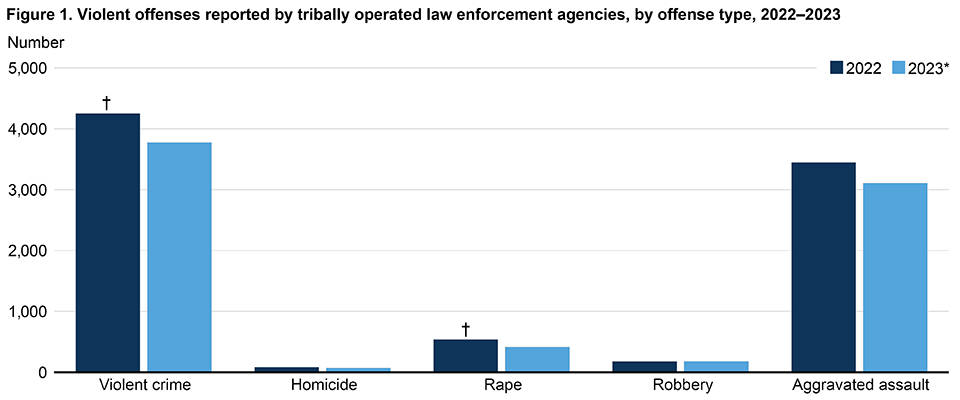
Note: Violent crime includes the offenses of homicide, rape, robbery, and aggravated assault. The 2022 National Incident-Based Reporting System estimates were updated to reflect data transmitted to the FBI after the 2022 cutoff date. See appendix table 1 for estimates and root mean square errors.
*Comparison year.
†Difference with comparison year is significant at the 95% confidence level.
Source: Bureau of Justice Statistics and Federal Bureau of Investigation, National Incident-Based Reporting System Estimation Program, 2022–2023.
Download Figure 1 in .xlsx format (32K)
Tribally operated law enforcement agencies cleared a larger percentage of rape offenses in 2023 than in 2022
- In 2023, 55% of total violent crime offenses were cleared by tribally operated law enforcement agencies (figure 2). This was not significantly different from the 54% cleared in 2022.
- The percentage of cleared homicide offenses declined from 61% in 2022 to 42% in 2023. Similarly, the percentage of robbery offenses cleared in 2023 (29%) declined from 2022 (42%).
- Tribally operated law enforcement agencies cleared 33% of rape offenses in 2023, an increase from 27% in 2022.
- Nearly 60% of aggravated assault offenses were cleared in both 2022 and 2023.
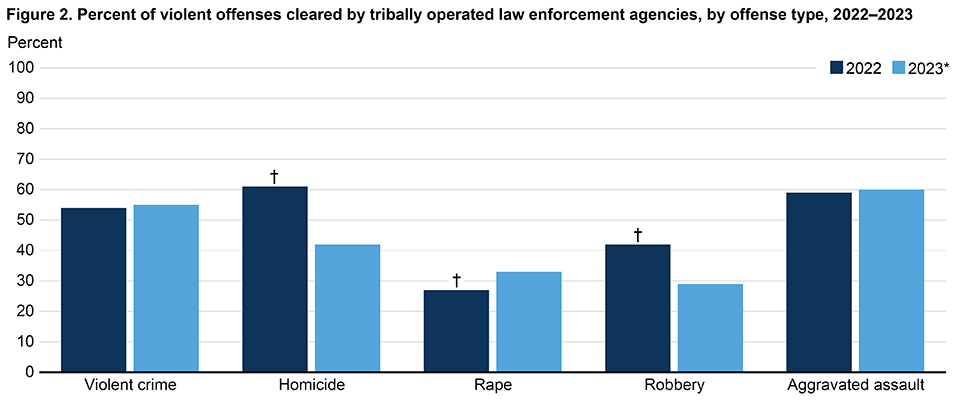
Note: Violent crime includes the offenses of homicide, rape, robbery, and aggravated assault. Percent cleared includes cleared by arrest and exceptional clearance. See About the data. The 2022 National Incident-Based Reporting System estimates were updated to reflect data transmitted to the FBI after the 2022 cutoff date. See appendix table 2 for estimates and root mean square errors.
*Comparison year.
†Difference with comparison year is significant at the 95% confidence level.
Source: Bureau of Justice Statistics and Federal Bureau of Investigation, National Incident-Based Reporting System Estimation Program, 2022–2023.
Download Figure 2 in .xlsx format (11K)
About the data
Violent crime includes the offenses of homicide (composed of murder and nonnegligent manslaughter), rape, robbery, and aggravated assault. Cleared offenses include those that were cleared through arrest or through exceptional means. For individual offense definitions and clearance definitions, see the NIBRS User Manual.
BJS conducted correlated sample t-tests to determine whether differences in estimated counts and percentages in this report were statistically significant. In this report, statistical significance is reported at the 95% confidence level. All comparisons made in text are statistically significant unless otherwise stated. See figures for testing on specific findings. For additional details on significance testing, see Crime Known to Law Enforcement, 2023 (NCJ 310188, BJS, November 2025).
The National Incident-Based Reporting System (NIBRS) is a data collection system designed and maintained by the FBI. The NIBRS Estimation Program (NIBRS EP), administered by the Bureau of Justice Statistics (BJS) in partnership with the FBI, produces national and subnational estimates of crime at the incident level using reported NIBRS data. For more information about the NIBRS data structure and details about the data elements included in the collection, see BJS’s NIBRS webpage and the FBI’s NIBRS webpage. For details on the research methodology for the NIBRS EP, see NIBRS Estimation and Extract File Creation Methodology Report (NCJ 310516, BJS, December 2025).
The agencies represented in this report are law enforcement agencies operated by tribal governments, a subset of law enforcement agencies typically not examined in estimates of reported crime. There are approximately 326 federally recognized tribal lands in the continental United States; in 2023, 215 tribally operated law enforcement agencies were eligible to report crime via NIBRS. Estimates of tribal crime in 2023 were based on data received from 202 tribally operated law enforcement agencies (94%); estimates in 2022 were based on data received from 201 agencies (93%). For more information about tribally operated law enforcement agencies and criminal jurisdiction over crimes committed in Indian country, see BJS’s Tribal Crime and Justice webpage.
2022 | 2023* |
| |||
|---|---|---|---|---|---|
Offense type |
| Root mean |
| Root mean | |
| Violent crime | 4,250† | 517 | 3,780 | 534 | -11% |
| Homicide | 90 | 12 | 70 | 10 | -15 |
| Rape | 540† | 76 | 410 | 46 | -23 |
| Robbery | 180 | 32 | 180 | 24 | 1 |
| Aggravated assault | 3,450 | 460 | 3,110 | 487 | -10 |
| Note: Violent crime includes the offenses of homicide, rape, robbery, and aggravated assault. The 2022 National Incident-Based Reporting System estimates were updated to reflect data transmitted to the FBI after the 2022 cutoff date. *Comparison year. †Difference with comparison year is significant at the 95% confidence level. Source: Bureau of Justice Statistics and Federal Bureau of Investigation, National Incident-Based Reporting System Estimation Program, 2022–2023. Download Appendix Table 1 in .xlsx format (33K) | |||||
2022 | 2023* | |||
|---|---|---|---|---|
Offense type | Percent | Root mean | Percent | Root mean |
| Violent crime | 53.8% | 1.89 | 54.8% | 2.31 |
| Homicide | 60.6† | 2.66 | 41.7 | 4.19 |
| Rape | 26.9† | 1.40 | 32.9 | 2.39 |
| Robbery | 41.6† | 4.80 | 28.9 | 2.51 |
| Aggravated assault | 58.5 | 2.08 | 59.6 | 2.46 |
| Note: Violent crime includes the offenses of homicide, rape, robbery, and aggravated assault. Percent cleared includes cleared by arrest and exceptional clearance. See About the data. The 2022 National Incident-Based Reporting System estimates were updated to reflect data transmitted to the FBI after the 2022 cutoff date. *Comparison year. †Difference with comparison year is significant at the 95% confidence level. Source: Bureau of Justice Statistics and Federal Bureau of Investigation, National Incident-Based Reporting System Estimation Program, 2022–2023. Download Appendix Table 2 in .xlsx format (32K) | ||||
The Bureau of Justice Statistics of the U.S. Department of Justice is the principal federal agency responsible for measuring crime, criminal victimization, criminal offenders, victims of crime, correlates of crime, and the operation of criminal and civil justice systems at the federal, state, tribal, and local levels. BJS collects, analyzes, and disseminates reliable statistics on crime and justice systems in the United States, supports improvements to state and local criminal justice information systems, and participates with national and international organizations to develop and recommend national standards for justice statistics. Kevin M. Scott, PhD, is the acting director.
This report was written by Lizabeth Remrey, PhD. Stephanie Mueller verified the report.
Jonathan Fusfield edited the report. Jeffrey Link and Priscilla M. Fauntleroy produced this report.
May 2026, NCJ 310766